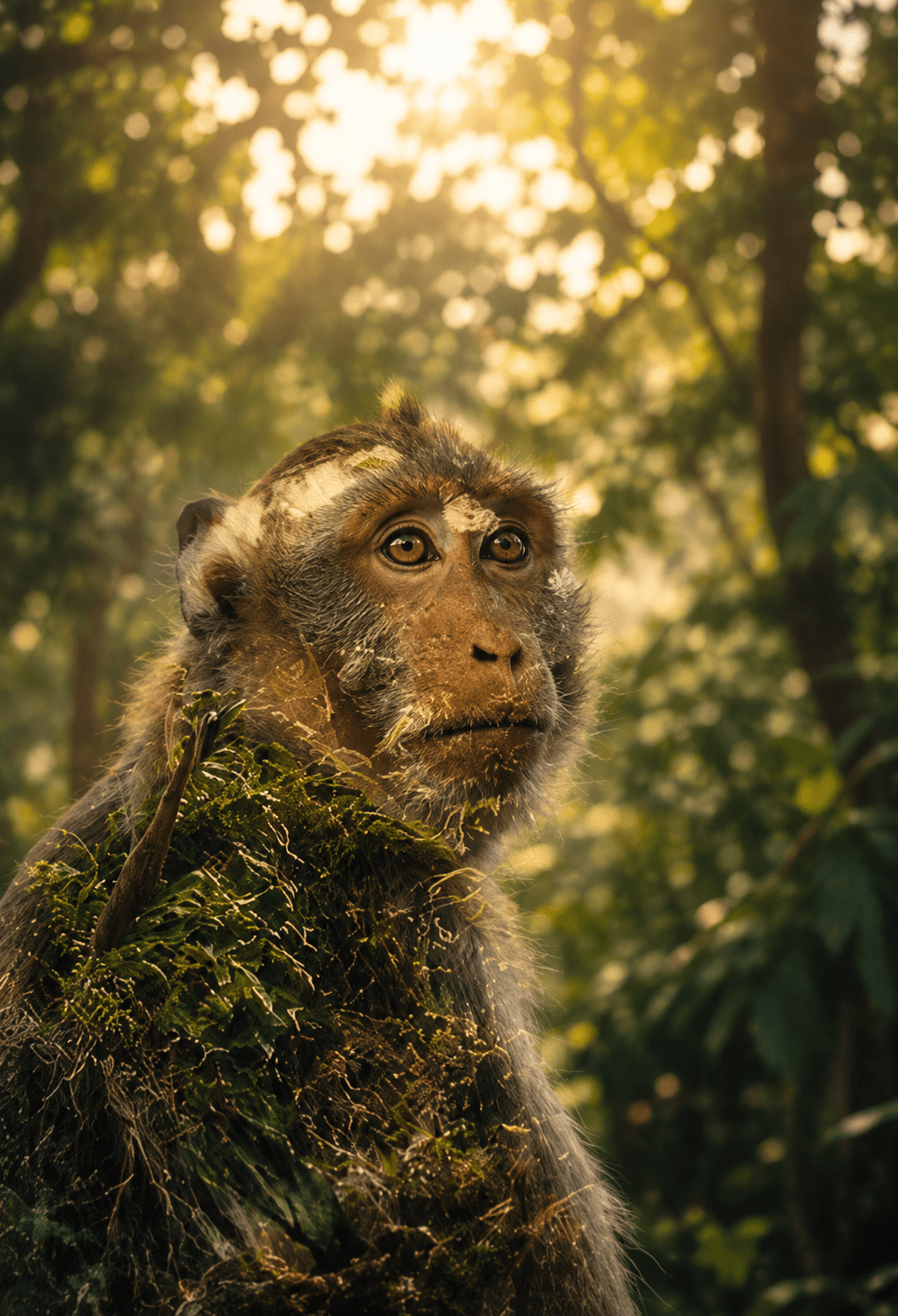
Living on Koh Phangan, I occasionally see monkeys being transported to work in the coconut plantations. It is one of those sights that most visitors either do not notice or quickly grow accustomed to. The monkey sits quietly in the back of a pickup truck or on a scooter trailer beside its handler as they make their way towards the groves of coconut palms that dot the island. Around them, everyday life continues uninterrupted. Scooters weave through traffic, tourists head towards the beach, and market vendors arrange fruit beneath colourful awnings. Yet each time I encounter one of these monkeys, I find myself returning to a question that has become increasingly important to me while writing my forthcoming book, Rewild Yourself.
Why do animals have to work?
At first glance, the question appears straightforward. Humans have worked alongside animals for thousands of years. Horses have pulled ploughs and carried riders. Oxen have hauled goods and cultivated fields. Dogs have guarded homes and herded livestock. From this perspective, the monkey harvesting coconuts may seem like little more than another example of a longstanding relationship between humans and animals.
Yet I find myself hesitant to dismiss the question so easily, perhaps because the monkey occupies a peculiar place in our imagination. Unlike a horse or an ox, a monkey appears uncomfortably familiar. We recognise something of ourselves in its movements, its expressions, its curiosity, and perhaps even its capacity for boredom. Watching a monkey climb a coconut tree at the command of a human being raises questions that extend far beyond labour and efficiency. It touches upon agency, purpose, and freedom.
Recently I came across an article in Phanganist in which local coconut farmers responded to allegations of animal cruelty directed towards the industry. The farmers argued that the monkeys are not abused and that they are cared for as valued companions rather than exploited labourers. Reading the article, I felt sympathetic to their frustration. Too often, discussions surrounding traditional practices become flattened into simplistic narratives in which one side is cast as enlightened and the other as ignorant. Reality rarely conforms to such neat moral categories.
At the same time, I feel equally unsatisfied by the assumption that proper care automatically resolves the ethical dilemma. The question of whether the monkeys are fed, sheltered, or protected is undoubtedly important. Yet it seems to me that another question sits beneath these concerns, one that receives far less attention because it is considerably more difficult to answer.
Even if a monkey is well cared for, what does freedom mean for a monkey?
This question emerged while I was writing a chapter of Rewild Yourself that explores different forms of freedom. Modern societies often speak of freedom as though it were a single, unified concept. We assume that more freedom is always better and that freedom itself is self-evidently desirable. Yet the longer I reflected on the subject, the more convinced I became that not all freedom is equal.
There is a significant distinction between authentic and inauthentic freedom.
Authentic freedom encompasses the freedom to express one’s nature. It includes the freedom to think, to create, to explore, to love, and to become. It is expansive rather than restrictive. It invites participation in life rather than withdrawal from it. Authentic freedom is inherently dynamic because it involves engagement with uncertainty. It asks something of us. It requires courage, adaptability, and responsibility.
Inauthentic freedom, by contrast, often emerges from fear. It presents itself as freedom, but it is primarily concerned with insulation from risk. It manifests as the freedom to consume without limits, the freedom to exploit without consequence, or the freedom to pursue personal security regardless of wider implications. It seeks protection rather than participation. It attempts to eliminate uncertainty rather than engage with it.
While writing Rewild Yourself, I found German philosopher Erich Fromm’s distinction between freedom from and freedom to particularly useful in clarifying this difference. Freedom from refers to the absence of constraints. It is freedom from oppression, freedom from hunger, freedom from danger, freedom from insecurity. These freedoms matter profoundly. Few people would willingly choose oppression over liberty or hunger over nourishment. But freedom from does not necessarily produce a meaningful life. It merely removes obstacles.
Freedom to, on the other hand, concerns what becomes possible once those obstacles have been removed. It is the freedom to create, to imagine, to explore, to participate fully in existence. It is the freedom to express one’s nature rather than simply avoid suffering.
This distinction has become increasingly relevant in contemporary society. Much of modern life revolves around the pursuit of freedom from. We surround ourselves with insurance policies, surveillance systems, safety regulations, contractual guarantees, and increasingly controlled environments. We seek protection from uncertainty at every turn. Entire industries have been built upon the promise of making life safer, smoother, and more predictable.
There is, of course, nothing inherently wrong with seeking safety. The problem arises when the pursuit of security becomes so dominant that it begins to crowd out the possibility of genuine aliveness. Every effort to eliminate uncertainty narrows the space in which discovery can occur. Every attempt to remove risk also removes certain forms of possibility. We become increasingly protected and increasingly constrained at the same time.
This is where the monkeys return to the conversation.
Defenders of the coconut industry often point out that many working monkeys enjoy conditions that are preferable to those found in zoos, circuses, or laboratories. They are fed, cared for, and protected. In some cases, strong bonds appear to exist between handlers and animals. These observations may well be true.
However, I cannot help wondering whether this comparison already limits the scope of the discussion.
If the benchmark for freedom is that one form of captivity appears preferable to another, then perhaps we are no longer discussing freedom at all.
A monkey in a plantation may possess a certain degree of freedom from. It may enjoy freedom from starvation. Freedom from predation. Freedom from some of the dangers that accompany life in the wild.
But does it possess freedom to? Does it possess the freedom to wander according to its own instincts? To form relationships independently? To spend its life pursuing the activities that emerge naturally from its own way of being in the world?
The more I consider these questions, the more I find myself drawn towards an animistic perspective.
Animism begins from a fundamentally different understanding of the world than the one that dominates industrial societies. Rather than viewing animals as resources, tools, or biological machines, animism recognises them as beings with their own forms of agency and purpose. An animal is not merely something that exists for human use. It possesses its own experience of life, its own relationships, its own interests, and its own place within the wider web of existence.
From an animistic perspective, the monkey is not simply a labourer. Nor is it merely an economic asset. It is a participant in the world whose life cannot be fully reduced to the functions it performs for human beings.
This perspective does not automatically provide answers. In fact, it often makes ethical questions considerably more complicated. After all, nature itself is not a realm of perfect freedom. Wildness carries its own burdens. Forests contain predators. Food can be scarce. Disease and injury are ever-present realities. To romanticise the jungle as a place of absolute liberation would be as misleading as romanticising captivity as a form of protection.
The challenge lies in recognising that safety and freedom are not identical. A protected life is not necessarily a free life.
The distinction becomes clearer when applied to humans. Many of us willingly organise our lives around security. We choose careers that provide stability even when they diminish our sense of purpose. We remain within familiar routines because they shield us from uncertainty. We seek comfort, predictability, and control, often at the expense of curiosity, spontaneity, and growth.
In doing so, we frequently exchange freedom to for freedom from.
We become free from financial insecurity while losing the freedom to pursue meaningful work. We become free from uncertainty while losing the freedom to explore. We become free from risk while losing the freedom to discover who we might become. Or to quote one of my favorite Pink Floyd songs:
… Did they get you to trade your heroes for ghosts?
Hot ashes for trees? Hot air for a cool breeze?
Cold comfort for change? Did you exchange
A walk-on part in the war for a lead role in a cage?
This is why the image of the monkey on the back of a pickup truck continues to occupy my thoughts. The monkey’s situation is not identical to ours, but it illuminates the same underlying tension. It raises questions about the relationship between protection and possibility, between security and self-expression, between safety and freedom.
French existentialist philosopher Jean-Paul Sartre famously wrote that we are condemned to be free. The statement is unsettling because it reminds us that freedom is not merely a privilege. It is also a burden. To be free is to confront uncertainty. It is to navigate a world without guarantees. It is to accept responsibility for one’s choices rather than surrendering them to external structures.
Perhaps this is why cages are so appealing, whether they are made of metal bars or social expectations. Cages relieve us of uncertainty. They reduce complexity. They provide reassurance. What they rarely provide is the opportunity to become fully what we are.
The monkeys of southern Thailand leave me with no simple conclusions. I don’t know whether a working monkey is happier than a monkey living in a shrinking forest. I don’t know whether traditional relationships between handlers and animals can be understood entirely through the language of exploitation. Nor do I believe that simplistic moral judgments are capable of capturing the complexity of the situation.
What I do know is that the debate forces us to think more carefully about what we mean when we speak of freedom.
If a monkey is well fed, protected from danger, and cared for throughout its life, yet spends that life serving human purposes, is it free?
The answer depends entirely on what we mean by freedom. If freedom is merely freedom from hunger, fear, and uncertainty, then perhaps the answer is yes. If freedom also includes the ability to express one’s nature, to follow one’s instincts, and to participate in life on one’s own terms, the answer becomes far less clear.
Perhaps this is why the image of a monkey on its way to work feels so unsettling. It confronts us with a dilemma that extends beyond animal welfare and into the heart of our own lives. We, too, are constantly negotiating the boundary between safety and aliveness, between security and self-expression, between the comforts of the cage and the uncertainties of the jungle.
Rewilding is ultimately an attempt to reclaim the freedom to. The freedom to explore, to create, to love, to risk, to wonder, and to participate fully in the living world. Whether that freedom is possible for a coconut-harvesting monkey, I don’t know.
The fact that I cannot answer the question may be precisely why it matters.


Hello sweety
How is Bali ? Settling?
Is this your email ? kristine_harper@yahoo.dk
Want to let you know that I am moving from gmail to protonmail. I will stop using Gmail as of mid august.
This is my new email : arunamariannesingh@proton.me
Hope we can keep in touch there,
Love Aruna
LikeLike
Yes love – sorry – I only just saw this. Hope you are well!! hugs
LikeLike