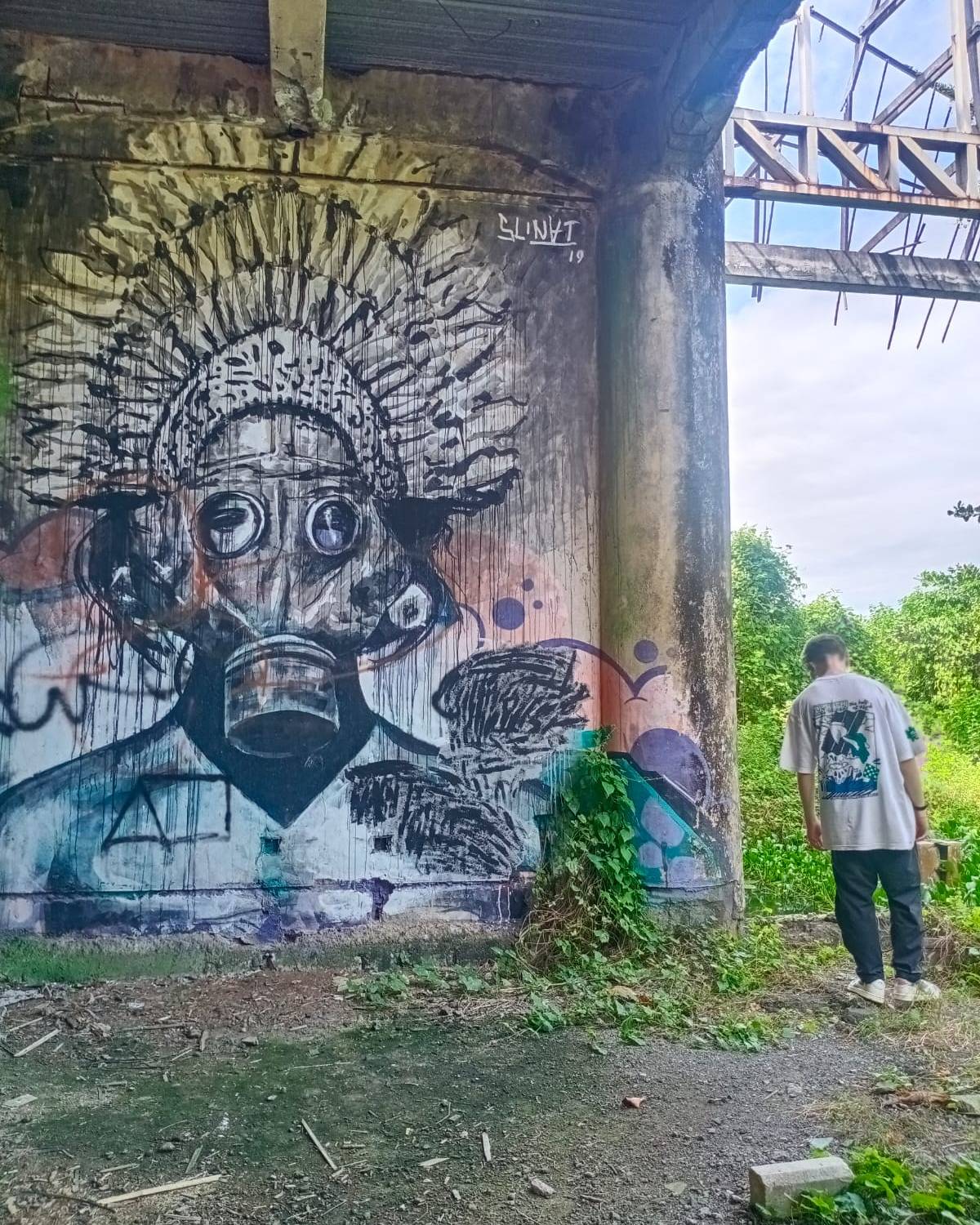
This post is another extract from my new Uncultivated book project. As previously described the book is built up around negations of “the ten commandments of cultivation”. The intention herewith is to challenge taken-for-granted cultural and societal “truths” and assumptions and to promote a rewilding of the cultivated human being.
The ten commandments are the following:
- We have to adapt and behave
- We are superior to animals
- We are separated from nature
- We must be ambitious
- We have to work hard
- What cannot be explained is not true
- We do not talk about death
- Decay must be defeated
- Time is linear
- God is dead
In this post I will share a passage from the section: What cannot be explained is not true. This section is a description of an eerie experience I had this weekend together with my oldest son.
Sometimes what cannot be explained is true.
***
What cannot be explained is not true
It’s a steaming hot Sunday as I ride my motorbike, my 15-year-old son on the back, through the jungle towards the coast. Our destination is an abandoned amusement park, Taman Festival Park, that has apparently been overtaken by tropical nature and graffiti art.
We don’t know exactly what to expect—just a few intriguing photos I saw online and a tip from a friend.
When we arrive at the empty parking lot, we’re greeted by a man who claims we have to pay an entrance fee to him. The amount seems reasonable, and I’m not in the mood to negotiate, so we pay. He points us towards a set of stairs and, with a wry smile, adds: “Good luck.” We laugh it off but can’t help feeling a little unsettled as we head through the graffiti-covered ticket booths with shattered glass.
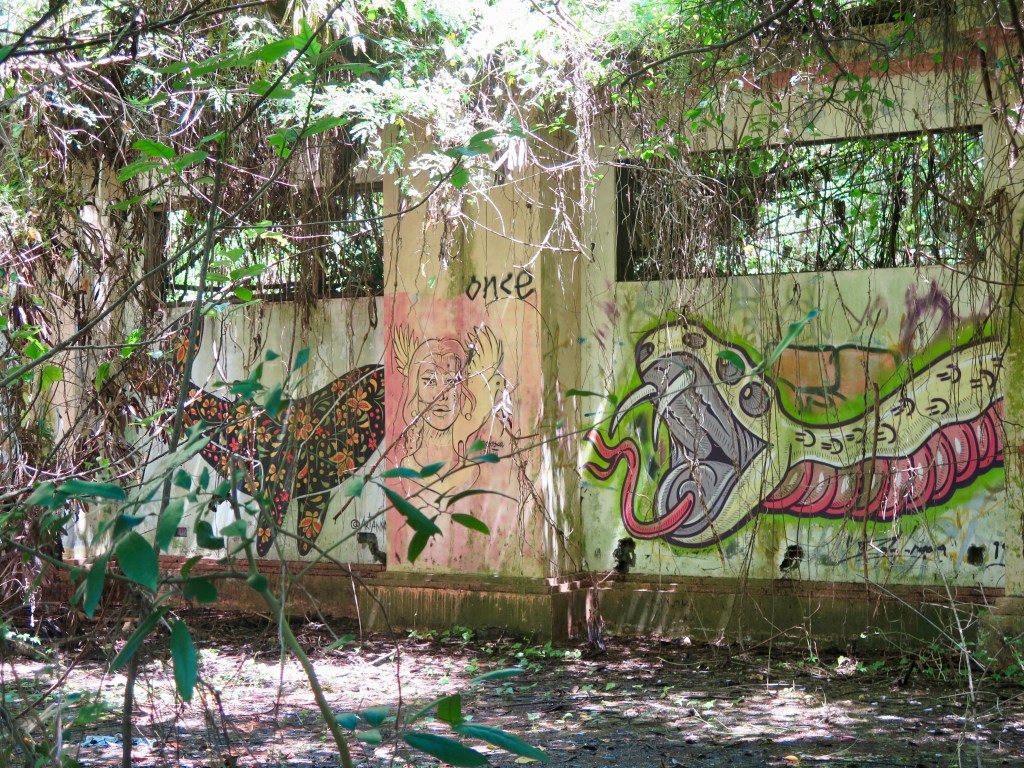
Strangely there are no dogs in the park. Stray dogs are everywhere in Bali, and as we enter the parking area, we see a bunch of scruffy looking dogs roaming the beach, but for some reason the park is completely dog less. The only living creatures we encounter are a multitude of mosquitoes, piles of wriggling centipedes, swallows and bats. Besides therefrom the park is cleared of visible life. A couple of other visitors are here; two young men with cameras, who are leaving as we enter, nodding at us quietly as a greeting. The atmosphere is eerily peaceful. The only sounds are the howling winds and the ocean.
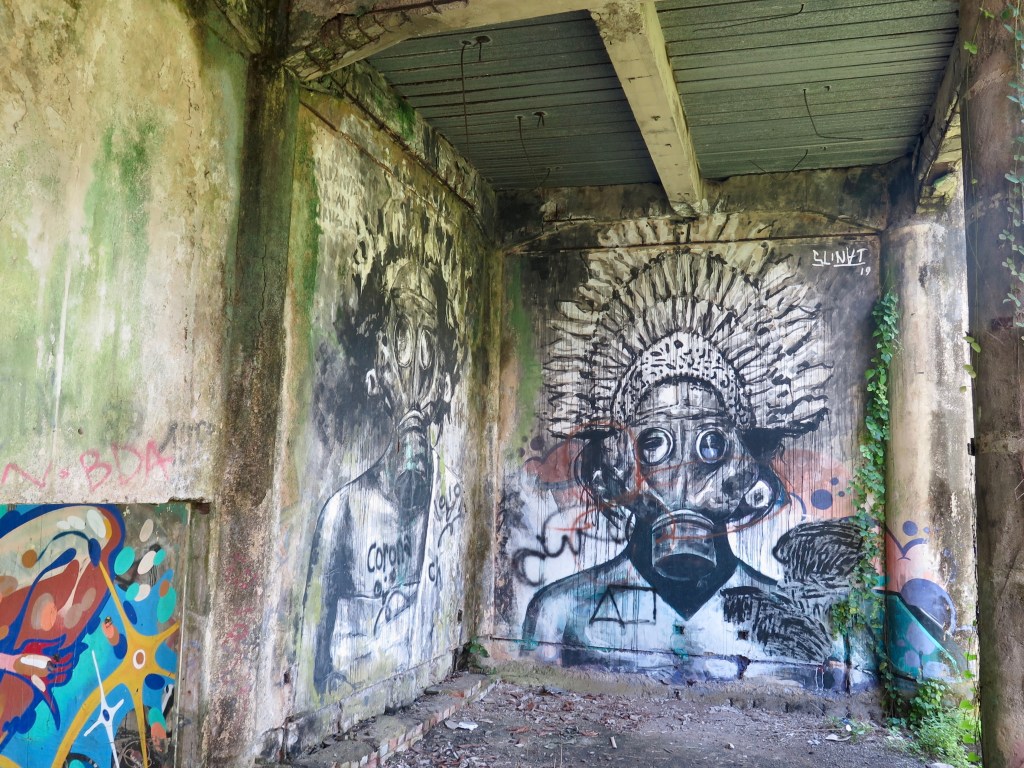
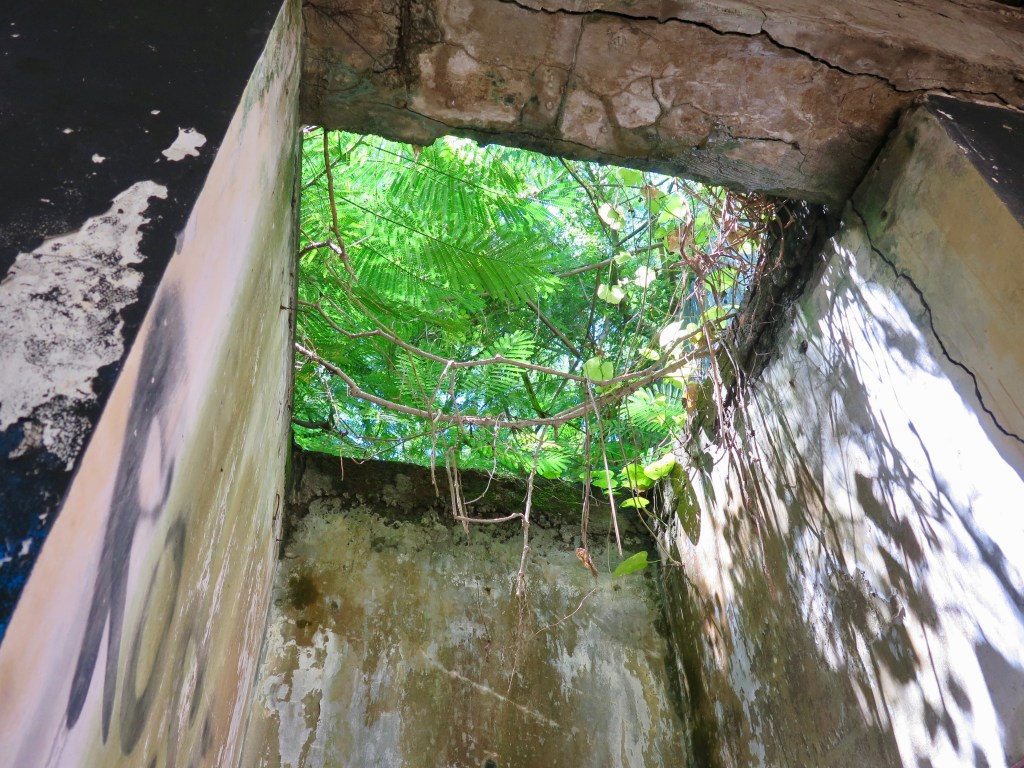
We walk further into the park, where enormous ruined buildings loom before us. Their windows are shattered, roofs missing, and vines and tropical flowers snake through the cracks. Some of the graffiti is stunning—vibrant, rebellious, but somehow peaceful in its decayed surroundings. We are in awe. The juxtaposition of decay and nature feels oddly beautiful. We take photos, walking slowly through what used to be a grand atrium. The stairs to the second floor are still intact, barely, though overgrown with leaves. We climb them cautiously, and from the top, we are rewarded with a sublime view of the ocean and the colossal ruins draped in greenery.
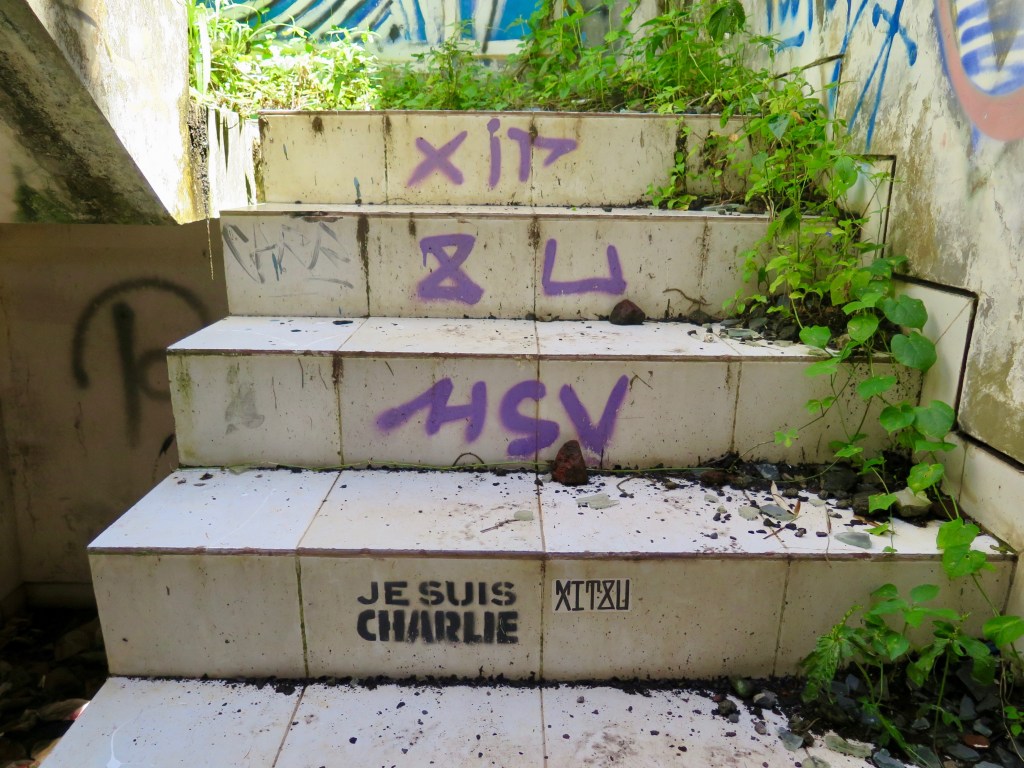
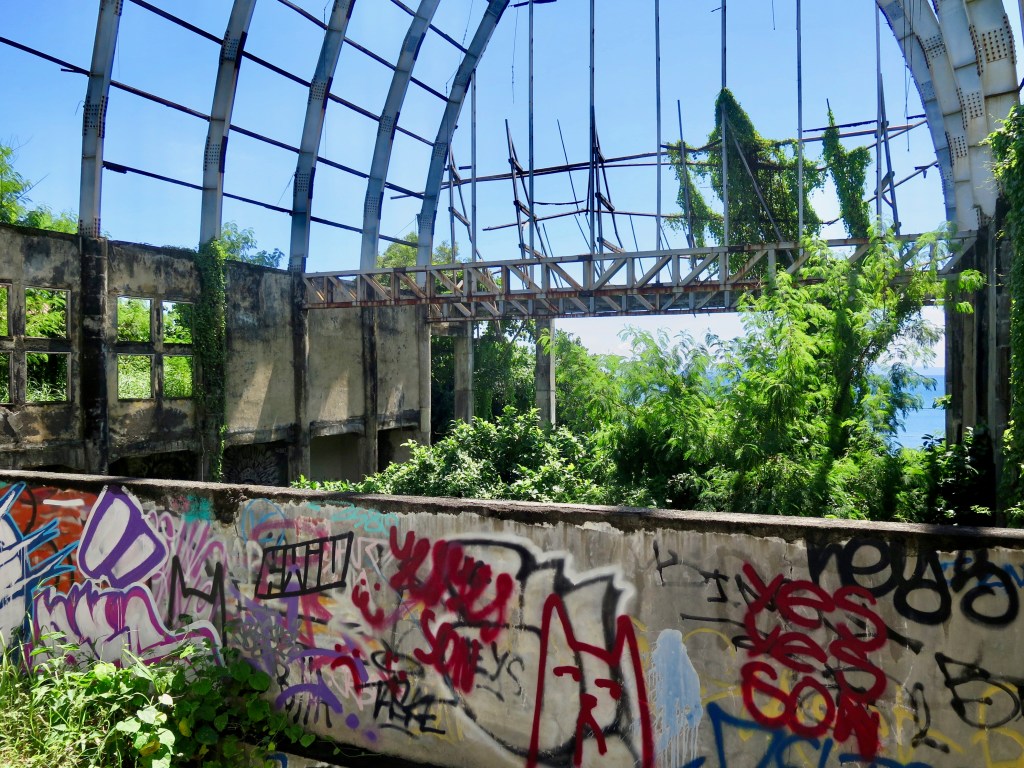
The beauty of the place is striking, but there’s an underlying tension we both feel—something isn’t quite right.
We move on, stepping into a square where a shattered fountain sits in the center. You can almost sense the grandeur this place must have had when it was new, bustling with life. We approach another massive building covered in graffiti. A large snake mural glares down at us, and we realize it’s the remains of a movie theater. It’s dark inside, too dark. Everything in me screams: Don’t go in. My son feels it too. “Let’s skip it,” he says, and I’m relieved.
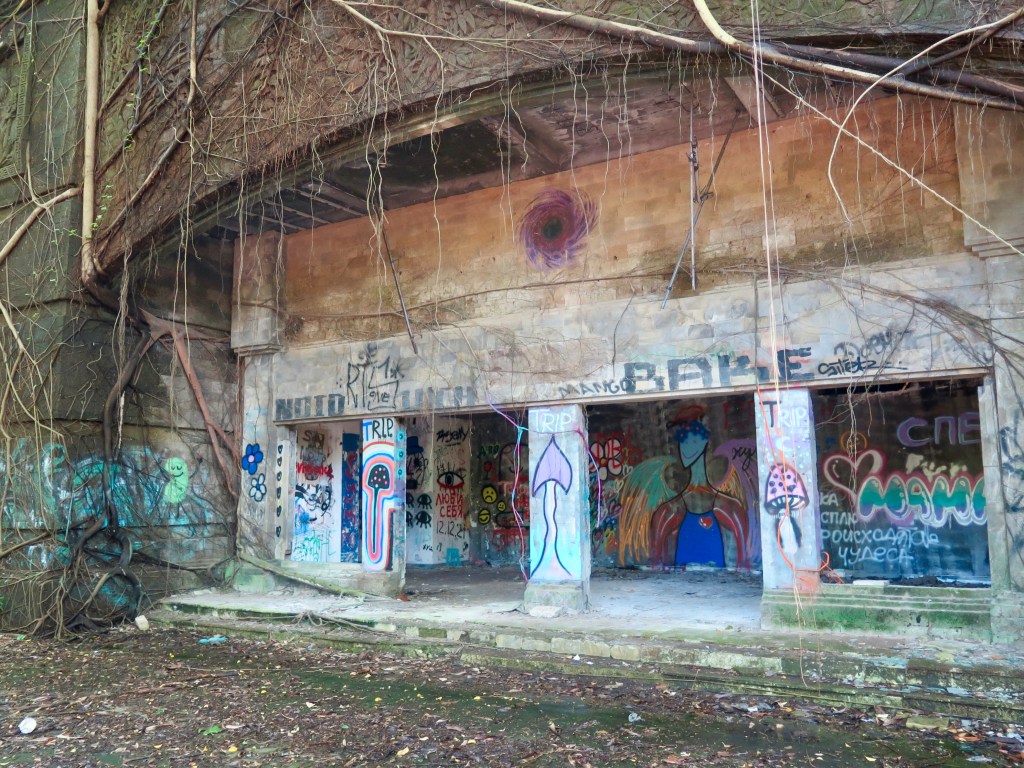
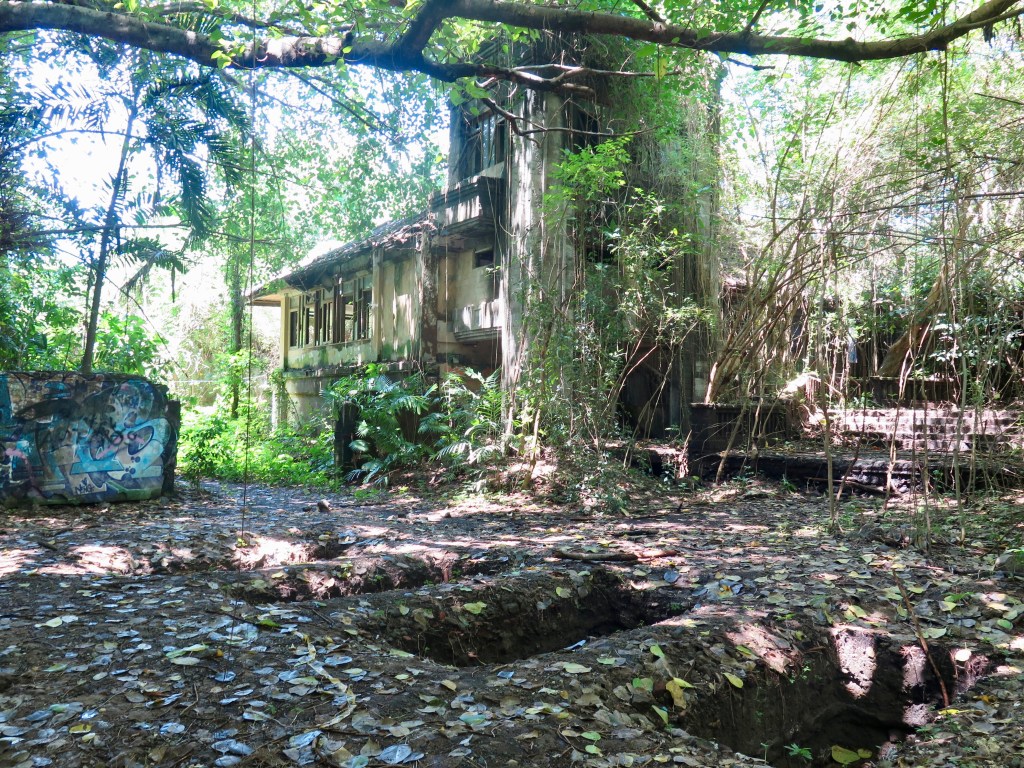
We decide to continue and pass through a gate covered in thick vines and leaves and enter a courtyard. Strange holes are dug in the soil – they look like freshly dug graves and my son and I send each other a bewildered look. What are those holes for? He asks me. No idea, I say, should we leave? No, it’s ok, lets walk through here and check out the building over there. He points to some wide steps that lead up to a massive decaying building with a surrounding colonnade. I hesitate for a bit and then nod at him.
As we walk through the courtyard, we pass a tall chapel-like building which, strangely, isn’t plastered in graffiti. Plants have almost completely taken over its walls and tropical vines are hanging from the roof. There is a small overgrown passage next to it, and as we look down it suddenly an orange scooter driven by an old Balinese man with grey hair passes. A small boy is sitting on the back of the scooter holding on to the old man. They pass, and then disappear. And we think nothing of it at the moment.
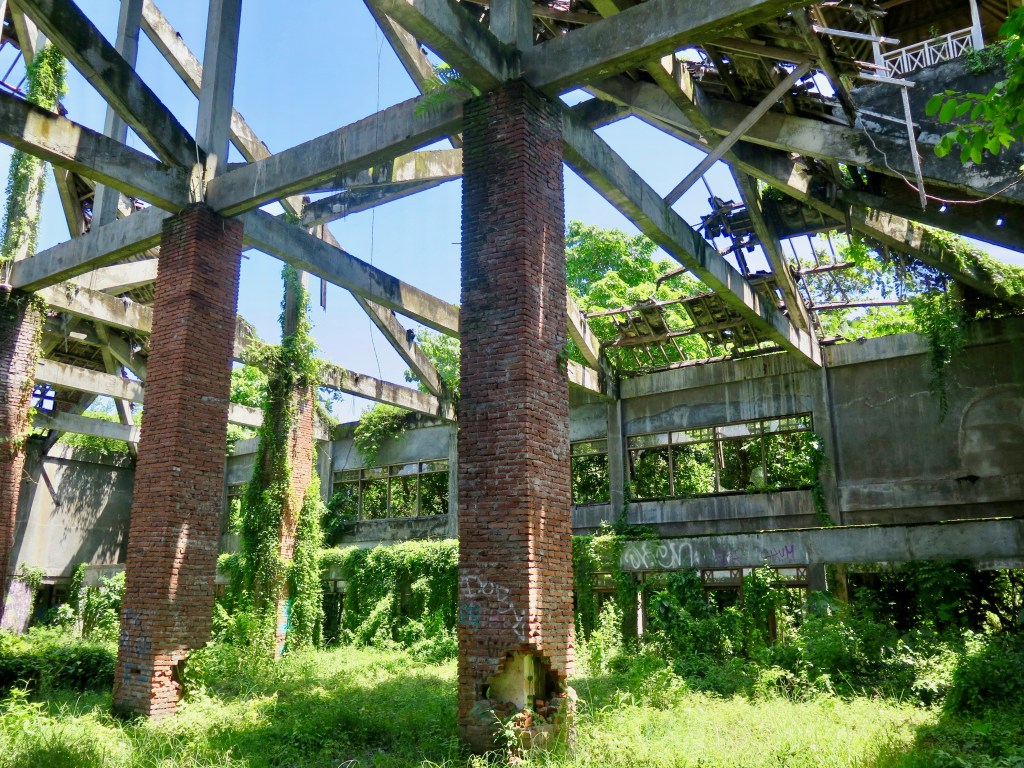
As we walk into the grand crumbling colonnade surrounding the massive structure swallows fly out towards us, and bats are hanging from the ceiling. I am really not a big fan of bats, and my son knows, but he says: let’s just check out the open area, then we can leave. I nod, and we continue. The ground of colonnade is covered in rainwater and the graffitied walls are reflecting in the water giving the sight an illusion of abolition of up and down. We walk into the massive demolished center of the building; the iron structure is the only thing still standing and loose pieces of timber are hanging from it, giving it a very unsafe look.
As we walk back through the overgrown gate into the sunlight, away from the swarms of mosquitoes, my son suddenly says, “Where did that man disappear to?”
“What man?” I ask.
“There was a man right there,” he says, pointing to a clearing. “He was wearing a gray shirt. He was right there, but now he’s gone. Did you see him?” I shake my head, unsettled.
We walk slowly towards a few more graffitied shattered buildings, take some photos, and then decide we have had enough. We are both quiet, contemplating. As we ride home, we both exclaim: holy s…, what was that place all about?!

After returning home we are so filled up with the overwhelming impressions from the park that we begin to frantically read everything we can find about it. The story of Taman Festival Park is insane. The 9-hectare amusement park that sprawls along the southern coast of Bali was built in the late 1990’s by the Indonesian government as a major tourist attraction.
The park was to feature a fancy 3D theatre, laser shows, an erupting model of a volcano, a swimming pool planned to be the largest in Bali, an inverted roller coaster, and a crocodile pit. However, on a Friday (the 13th, as a matter of fact!) in March 1998 lightning struck the park and destroyed the expensive laser equipment as well and some of the buildings. Insurance didn’t cover natural disasters and the park was never completely finished and never opened. The park has now been abandoned for over two decades and has been more or less swallowed by the jungle.
We also read about visitors being observed and followed from a distance as they walked through the park – by a young boy with a shaved head and by a skinny man – only to lose sight of their followers as they reapproached the entrance/exit. And about how these visitors after returning home fell sick and were bedridden for days. We read about the park being the most haunted place in Bali: about the spirits (some evil) that roam the park, and about how locals never enter, because, as they say: nothing living ever comes out of there. We read about how locals do offerings that include animals (chickens, goats and pigs) every fortnight at entrance area of the park to ensure that the spirits stay content and remain within the park. And about how those offerings are always gone when they return in the morning.
We read stories about the crocodiles that were left behind when the park was deserted and about rumours that the crocodiles initially were fed chickens by local farmers, but later started eating each other as well as humans. It is said that the last crocodiles were finally removed, but this has never been confirmed (and I start to wonder why there absolutely no dogs in the park). These stories all add to the unease that we both felt when we were in there; a feeling that made us stick close to the entrance area and forced us to comprise our curiosity to explore more and wander deeper down the overgrown paths of the park.
Then, my son finds something that makes him pale. He reads aloud about a motorbike and vintage scooter show that was held at the park just before it was supposed to open to the public.
He turns to me, shaking. “The orange scooter…”
I know what he’s thinking before he says it. The orange scooter we saw—driven by the old man, with the boy on the back—couldn’t have been real. Not in the overgrown, vine-covered area we walked through. And why had we heard nothing after they passed us? There was no hum of an engine, no rustle of movement. Only silence.
“I’m never going back there,” he says, his voice barely a whisper. I can’t explain what we experienced that day. But it was real.
 The Immaterialist
Thank you! I am so happy about your challenges of the 10 commandments – I crave for this transformation…before it is too late.
LikeLiked by 1 person